
Serverless Databricks pricing: still DBU × SKU
Guide · Cost pillar · List-price education · Not contract pricing
Serverless does not mean “no DBU.” You still pay Databricks units × the $/DBU for that serverless SKU. What usually changes is the infrastructure story: you are not picking EC2/Azure VM types the classic way, and the old “idle cluster still burns VM $” model does not transfer 1:1.
If someone says “we moved to serverless so the calculator is obsolete,” push back: the meter is still DBU — the shape of the estimate changes.
Topic summary · original diagrams · no autoplay
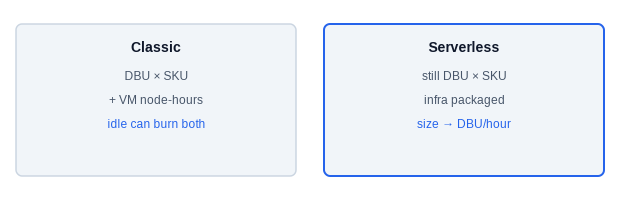
Classic vs serverless (estimate shape)
| Classic Jobs / All-Purpose | Serverless (typical) | |
|---|---|---|
| Databricks line | DBUs × $/DBU (SKU) | DBUs × $/DBU (serverless SKU) |
| Infra line | You size VMs → separate cloud $ | Packaged; not “pick m5.xlarge” |
| Idle | Up cluster → DBU + VM until stop | No classic idle VM band; product warm/idle rules differ — read current docs |
| Size knob | Nodes × instance type | Performance / size tier → DBU per hour (product-specific) |
Always label outputs as list estimates. SKU names and DBU rates change — verify on official pricing pages.
Example (education numbers)
Nightly ETL, 30 runs/month, 20 minutes each → 10 hours/month of serverless job time. Illustrative serverless Jobs list: $0.30 / DBU. Size tier uses 6 DBU/hour (made-up for teaching — replace with your product card).
- DBUs ≈ 10 h × 6 DBU/h = 60
- DBU $ ≈ 60 × $0.30 = ~$18 / month (list estimate)
Same workload on classic Jobs (from our TCO walkthrough style): 4 medium workers × 15 h × 1.5 DBU/node-hour → ~90 DBUs at ~$0.15 ≈ ~$13.50 DBU plus ~$30 VM band ≈ ~$43.50 total rough. Serverless here shows a single DBU line; classic shows two. Neither number is your contract quote.
# Education sketch — replace rates with your SKU card
hours = 10
dbu_per_hour = 6          # serverless size tier
dbu_rate = 0.30           # list $/DBU (example)
dbu_cost = hours * dbu_per_hour * dbu_rate
# → ~18 USD list estimate / month
FAQ
Does serverless kill DBU math? No. It changes how infrastructure appears on the bill and which idle model you use. Cost = DBUs × $/DBU for that serverless product, unless your contract says otherwise.
Can I reuse the “idle fraction” from the classic calculator? Not blindly. Classic idle = cluster up with no queries. Serverless warm pools / auto-stop behave differently — check current product docs before modeling waste.
Will this site’s calculator get a serverless mode? Planned as a follow-on (Batch-1). Until then: use DBU × rate by hand, or override $/DBU in /tools/cost/ and set VM band near zero only when you have confirmed infra is fully packaged for that SKU.
Where do official numbers live? Start at databricks.com/product/pricing, then open the serverless / Jobs SKU card for your cloud. This page is education, not a quote.